Dr. M.P. Key of the District’s Society for the Prevention of Cruelty to Animals was outraged as he walked into the office of DC District Attorney Moore’s office at Police Court on Christmas morning of 1883. Over one arm hung a basket, from whose depths could be heard a curious fluttering.
The creature inside, he announced, had been on public display for several days at 941 Pennsylvania Avenue. The owners of the creature, Mssrs. Randolph Warrick and Henry Irving, had been placed under arrest for animal cruelty.
In what certainly had to be a memorable moment in DC legal history, Dr. Key opened the basket. Out jumped a headless rooster.
To the amazement of those who gathered to see the spectacle, the chicken had a well-developed body, neck and legs. However, most of its head appeared to be missing. Those who had the stomach to lean forward and examine the flustered bird more closely noticed that though its eyes and beak were absent, it did retain its ears and what appeared to be the base of the head.
Mssrs. Warrick and Irving appeared before Judge Snell some time later that day, represented by lawyer Campbell Carrington. Warrick explained that he had bought the curious bird from a Richmond man for $25. The former owner explained that the bird had been missing its head for over a year. It happened this way: the former owner from Richmond had chopped off the heads of a number of fowl one day. However, the bird in question refused to die. So the Richmond man had kept it alive by forcing feed down what he believed was its windpipe.
Warrick and Irving argued that they had received a permit to show the bird from Chief of Police Dye.
After lengthy arguments over the nature of animal cruelty, Judge Snell dismissed Irving but fined Warrick a hefty $50—twice what the latter had paid for the bird.
It was Snell’s opinion that exhibiting the bird amounted to animal cruelty—and any creature missing a brain had to be suffering.
He also publicly questioned why in the world Police Chief Dye would have given a permit to exhibit the poor bird.
Dr. Key placed the bird back inside the basket and left the courtroom. Meanwhile, Mr. Warrick told the press he was astonished by the verdict—why, Mr. Barnum of circus fame would likely be willing to pay $1,000 for such an oddity as the headless chicken.
That should have been the end of the matter…it was not. The following day—Boxing Day, when other Washingtonians were home still digesting their Christmas dinners of headless geese and suckling pigs, Warrick and his attorney Carrington were back in Police Court, appealing Judge Snell’s decision. Today, the defense was ready to scientifically prove that the headless rooster was not suffering. Carrington had arranged for an autopsy of the hapless fowl by the esteemed Deputy Coroner, Dr. Hartigan.
It was Hartigan’s observation that though the head had been removed and a greater portion of the bird’s brain was missing, a small portion remained in the base of the missing skull. Furthermore, he opined, since that portion of the brain which feels pain was located in that part of the brain that had been missing, the bird had not, in fact, suffered at all. If the bird were in pain, he pronounced, it would not have thrived as it had.
Furthermore, Dr. Hartigan stated, he had conferred with a number of other physicians, all of whom concurred with his diagnosis.
Judge Snell, however, stuck to his guns—as well as his previous judgment. “I think this is a demoralizing exhibition,” he said. “If this is allowed, we will have all the boys in the city trying to cut the heads off chickens.”
Hard by a poplar shook alway, All silver-green with gnarled bark: For leagues no other tree did mark The level waste, the rounding gray. She only said, "My life is dreary, He cometh not," she said; She said, "I am aweary, aweary, I would that I were dead!"
-- From “Mariana,” by Alfred Lord Tennyson
Every so often, Quondam Washington comes across a bit of history that she cannot explain.
This time the author is completely stymied and is forced to call upon her readership to see whether her research is faulty—or whether the facts are simply lost to history.
At issue is the legend of the “Dolly Barber Tree”, an ancient popular which once stood along what is now Reservoir Road in the vicinity of Foxhall Village and was once the trysting place of the 18th Century girl after whom it is named.
There is no doubt that the tree existed; from earliest times it was an important reference point for surveyors and is mentioned in old land surveys. It apparently marked the convergence of three important properties west of Georgetown, belonging to William Murdock, Henry Threlkeld and Henry Foxhall, all famous old names in West Georgetown history:
• Henry Threlkeld (1716-1781) was an early settler who bought "Alliance," an estate of 1,000 acres bordering on the Potomac River. This tract, part of which came to be known as Berlieth (the spelling has changed over the years), extended north from the river to include the grounds of what is now Georgetown University, Visitation Convent and farther north to the present-day Duke Ellington School of the Arts and the neighborhood now called Burleith.
• Henry Foxhall was an Englishman, said to be a friend of Thomas Jefferson's. Prior to coming to Washington, he had been a partner in an iron works firm in Philadephia. Arriving in Washington around 1799, he built a foundry at what is now Glover-Archbold Park. He lived at a expansive estate called “Springhill” in the vicinity of what are today 44th and P streets.
• Finally, William Murdock the Older, was a prominent early landowner in lower Frederick County, which in those days encompassed the entire Foxhall area. He was the son of Rev. George Murdock, a Marylander ordained in London's St. Paul's Cathedral in 1724, and the first rector of Rock Creek Parish (from 1726 until his death in 1761).
William’s first wife was the daughter of Col. Thomas Addision, and his father-in-law gave Murdock a portion of land at “Friendship”, a famous old estate which sat about a mile north of Georgetown where American University is now.
His son Col. John Murdock (b. 1734, d. 1791) was a partner in a lucrative tobacco export business with Uriah Forrest and Benjamin Stoddart, formed in 1783. John, in turn, had a son named William whom I believe plays some role in the Dolly Barber mystery.
The “Dolly Barber” tree has had brief mention in old newspapers:
On August 2, 1899, a huge summer storm hit Washington and took down an old local landmark called the “Dolly Barber Tree”, an event which at the time was so newsworthy that it was reported by the New York Times three days later.
Two years later, District surveyor Henry B. Looker submitted his annual report to Commissioners, in which he commented on the significant increase in the number of requests for land surveys—this, as citizens began spreading into the suburbs and formerly large tracts of land were divided and subdivided to accommodate them (Post, Aug. 2, 1901). Incidental to the report, Looker referred to a the “Dolly Barber Tree,” which he acknowledged as the cornerstone of several original Georgetown tracts. In order to preserve its exact site, “south side of the New Cut road west of Foundry Branch,” Looker’s office placed a permanent monument at the exact spot where the tree once stood, which carefully recorded auxiliary points for future land surveys. (Report of the Operations of the Engineer Department of the District of Columbia for the Year Ending June 30, 1900, Washington: GPO, 1900).
Developers of Foxhall Village in the 1930s, in promoting their new development, cited the romance of the site and made reference to the Dolly Barber Tree.
So, the tree existed—but where, exactly--and who, then, was Dolly?
References insist she was the daughter of “William Murdock”—which could be either the father of Col. John Murdock or his son, also named William. Regardless of which Murdock was her father, why did she carry a different surname?
The possibilities are interesting—but before QW and the reader get too carried away with theories, let us examine one or two clues that bear consideration:
• A Dorothy Barber is listed in the 22 August 1776 census of Frederick County’s Lower Potomack Hundred (the same general “neighborhood” as the Murdock family and the tree. She is described as being 11 years old, thus, born in 1765.
• Col. John Murdock, before his death in ca. 1791, writes a will in which he goes to some length to ensure that Dorothy Barber and her three teenaged children are provided for:
-->Fifthly it is my will and desire not withstanding anything herein before contained and I do expressly desire unto Dorothy Barberone hundred acres of land to be paid off for her by my said trustees immediately after my death to include the plantation where James Collins now lives and the house where the said Dorothy Barber now dwells to be bounded to the eastward by the Mill Branch and the southward by the east line of Whitehaven and to the westward and northward by such lines ... and to hold during her natural life the said premises and after her decease & will and desire the said land to John the son of the said Dorothy and his heirs forever provided nevertheless if the said John shall die before the age of twenty one years a without issue of his body living at the time of his death...His will states that Dorothy has three children: John, under age 21; Elizabeth, under age 18; and Mary, also under age 18.
• Consider another tantalizing clue: John’s son William is clearly a ne’er do well, implied in this segment of John’s will:
In the Name of God Amen. I John Murdock of George Town in Montgomery County and state of Maryland do make and ordain this my last will and testament. Whereas to my great uneasiness I have discovered that my son, William, does not possess care and prudence sufficient to qualify him for the management of our estate…[it is my will and desire to] pay and satisfy all such debts as may be justly due and owing from my son William …
• Box 40, folder 2 in the Jesuit Archives for Maryland at Georgetown University contains a number of warrants of resurvey and/or indentures between 1791 and 1824. Among them is an indenture (1822) between John Murdock alias John Barber. Could this be Dorothy’s son John, using both names?
As a final note, A. Boschke’s Topographical map of the District of Columbia, surveyed in the years 1856 '57 '58 and '59, shows an “M. Barber” as the owner of a land just northwest of Georgetown.
One chilly December morning in 1893, a Miss Elsie Ough, the daughter of a prominent Canadian architect, was driving her father to work along the New Cut Road, which is today, Reservoir Road, through Georgetown and all the way to 14th and F Streets in the City, where his practice was located.
She drove her open buckboard wagon all the back through Georgetown.
The family home was said to be a pretty little cottage which sat on the left side of Conduit Road, past the water holding tank--at about two miles out the New Cut Road. Once outside of town, she would have trotted through open farmland where sheep and cows grazed, past the College Woods and the forests and meadows of what we now know as Glover Archibald Park.
She had just crossed a little stream at Foundry Branch when she felt her buggy jerk. Before she knew it, a man had leapt onto the back of her vehicle and had his hands about her throat. Elsie tried to cry out, but he carried a knife and threatened to use it on her if she made another peep. She would later tell the court that the man made indecent proposals to her.
The brave young woman resisted him and did scream; however, the area was so rural at the time that none could hear her. As the man and girl continued to struggle, her horse continued his trot toward home—and the feeding trough, no doubt.
They made it to the site of the Dolly Barber Tree*. At last, someone heard Elsie’s cries; Lazarus Whetzell was an elderly widower who happened to be working in his garden at the top of a rise above the water.
Elsie’s assailant, seeing that there was a witness, jumped down from the wagon and began to run down the road. However, he suddenly changed his mind and ran back toward the wagon.
Elsie lashed her poor horse as hard as she could and managed to race home before the stranger could get to her. She arrived home in a state of hysteria. Her shocked family summoned the police, to whom Elsie gave a description: The man had been wearing a blue coat with brass buttons—suggesting he might have been a naval cadet. He had run back in the direction of Aqueduct [Key] Bridge.
Once word got out, the rural neighborhood was outraged. Their excitement had not even begun to die down when another girl was assaulted. This time it was 13-year-old Annie Drury of Foxhall Road and her 15-year-old girlfriend and neighbor, Kitty Babcock, who were assaulted. They had been walking together when the man came from nowhere and made some of the same indecent proposals to them.
The description given by all three girls matched a certain young Georgetown resident, Milton Chamberlain. Police issued a warrant for his arrest, and just a few mornings later, Milton’s father James, a Thirty-Second Street grocer, hearing that one of his sons was suspected, brought both his sons to the Seventh Precinct Station House—Milton and Robert. When the girls positively identified Milton, Robert was allowed to return to school.
Police charged Milton with four counts of assault, battery and indecent language between the three girls. He was taken to Police Court, where Milton’s father was able to make the $500 bail Judge Miller ordered.
At the February 13 trial, Elsie testified as to the alleged attack on her by Milton Chamberlain back on December 18. Milton’s lawyer, a Mr. Campbell Carrington, argued the charge of criminal assault because no clothes were torn. However, the prosecution, Mr. Mullowney, countered that there was legal precedence for charging a man with criminal assault solely on the basis of his indecent remarks.
In March, the case went before Judge Cole’s criminal court. Milton’s mother Louise Chamberlain stated emphatically that he had never owned a blue coat with gold buttons. Family and several school friends and all came forth to speak for Milton. His one-time teacher at the JacksonSchool, Ms. Sarah M. Farr, wrote a letter to the editor of the Washington Post, pleading his case, reminding the public that he was only a few months out of knee pants. “Think of the innocent, fifteen-year-old boy sent to jail for ninety days, to be a companion of thieves, murderers and assaulters Mothers, tremble for your boys! Any one of them may be seized at any time to be a scapegoat of offended public feeling.” (Post, April 2, 1894, p. 5)
On April 4th, the jury found Milton guilty of simple assault. He was sentenced to ninety days in jail—however, his attorney, Mr. Carrington—or so it was initially reported--brought the matter to the attention of the President of the United States, Grover Cleveland. On or about May 14th, President Cleveland granted a full pardon and signed for the release of lucky young Milton, stating he believed the entire matter had been a case of mistaken identity.
Several days later, a presumed attorney by the name of Milton Myers wrote a letter to the editor of the Post. It stated that Carrington had nothing to do with bringing the matter before the President, that it was, in fact, Miss Farr and two other of his teachers who had petitioned the White House. (Post, May 17, 1894,p. 7)
Milton would go on to work as a clerk in his father’s grocery—and later, its butcher. He would marry a girl named Lucy; they would have a child who they would name Milton, Jr. He was a fireman at the Bureau of Mines at American University by age 40, when he registered for the World War I draft. After that, only his son Milton shows up in the records.
Elsie Ough never appeared again. Her family either moved away or she married soon thereafter.
Nothing more is known about Annie Drury.
Kitty Babcock remained living with her parents William and Gertrude in their house on the now obsolete Ridge Road, near Foxhall, for at least another fifteen years. After that, she too disappears.
No, it was not an elegant mansion on upper Sixteenth Street. The building carrying this soubriquet was a neglected three-story house on 6th Street NW, halfway between D and E Streets, where the Hyatt Regency-Capitol Hill now stands.
The building was nicknamed after its claimed owner, George S. Ryder*, who operated a rooming house whose inmates were well-known to police at the No. 6 Precinct—swindlers, fortune-tellers, loafers and pickpockets.
In January,1897, George was said to be not only old and grey, but recently paralyzed. He hardly sounded like the father of the five-year-old little girl named Abby K. Ryder who had just been removed from the house by Agent Parkman of the Children’s branch of the Washington Humane Society.
In fact, many doubted that old George really was Abby’s father. Including George himself. In a hearing January 2, he told Police Court Judge Miller he couldn’t be sure, though he loved her and wanted to provide for her as if she were his own. He even agreed to place her in the care of his lawyer, General William Birney. However, the court dismissed this possibility after Ryder failed to make arrangements for her move.
DC Police Officer Patrick J. Creagh, along with two other officers, Kelly and Lynch, testified that the residents of Ryder’s Castle were persons of immoral and corrupting character—why, the housekeeper, Mrs. Baxter, was an alcoholic. Worse, eh hmm, well, police had sneaked inside the house once to find Ryder and Mrs. Baxter in bed together—as well as the child!
It had been Creagh who, a few years earlier, passed by the old Castle and overheard a group of three young women were laughing riotously about a scam they had going: On Pension pay days, they would follow old soldiers and pick their pockets. They were so vociferous in planning the next day's outing that Officer Creagh arrested them on the spot and had them sent to the workhouse for sixty days. For at least that month, the neighborhood’s Civil War veterans were safe from assault.
Now, Ryder, in an effort to appease the court and keep little Abby with him, told the judge that he had evicted all the residents of the house—save for Mr. and Mrs. Percy and Maud Brown, who were elderly, and a Mr. Hawkins who was an old gentleman of color.
After investigating the situation, two weeks later, Judge Miller turned poor little Abby over to the Board of Children’s Guardians, a poorly-funded agency which, more often than not, placed children in public institutions rather than private homes.
Sadly—but not surprisingly—Abby never appears in any Washington census. What became of her is not known, unless one among our readers can shed any light.
As for the "castle": There had been some doubt all along that George Ryder was its legal owner. Sometime that year, the city had ordered Ryder to hook up to the sewer system, however he failed to do so. In September, Ryder was forced to admit that the property did not really belong to him, and pending charges were dropped.
That was the last time George Ryder made the newspapers.
Ryder Castle presumably fell into ruin...but not until far worse goings on were discovered there.
This would not be the last time the names Percy and Maud Brown appeared--in either newspapers, District court dockets or this blog.
*Not to be confused with the George Ryder of equestrian circles and society pages.
A reminder to all those Washingtonians who are currently excavating cars and sidewalks that Snowmaggedon has been visited upon Washington many, many times before...
Nineteenth and early Twentieth Century journalists loved a good mystery. Apparently, so do some Twentieth Century bloggers.
The Washington Post of May 10, 1904, carried the following tale of a mysterious stranger:
On a cold and blustery night in the mid 1860s, a cold and starving stranger knocked on the door of Georgetown’s Franklin Inn at 168 Bridge Street—later, 3249 M Street--asking for food and shelter. Innkeeper Ann Cleveland was the widow of John Cleveland, who had died in a tragic accident at the WashingtonMonument construction site. Sympathetic to the man, she ordered her servants to give him food and a place to lie down for the night. She told him not to leave in the morning until she had had a chance to speak with him.
The next morning, she offered the man, who called himself John Brown, a job as a general handyman. He accepted the offer and ended up working there, according to the Post, for two decades until Mrs. Cleveland’s death in 1888.
Mrs. Cleveland, prior to her death, had instructed her daughter Louisa Phipps to provide for Mr. Brown and, on his death, give him a respectable Christian burial.
Mr. Brown died at ProvidenceHospital in May, 1904, and true to her word, Louisa arranged for Father Smythe from St. Joseph’s Church on Capitol Hill to preside over the funeral. She buried John Brown in the family plot at HolyRoodCemetery in Georgetown.
Mr. Brown was as much a mystery to the family and neighbors at his death as he had been in life. He had appeared to be an educated man from a good family. He never divulged a single detail about his past, no matter how much pressure he was put under. He kept to himself, never making friends with either men or women.
The Post fancifully hinted he may have been connected to the infamous abolitionist by the same name—but of course, this would have been impossible, as the famous John Brown had been put to death in December, 1859.
Census returns show John Cleveland in Georgetown as early as 1840. The 1870 census shows a widowed Mrs. Cleveland and her children, as well as several servants and staff—among them, three Johns: Sweeney, Whelan and Haines, but no Brown. The 1880 census shows a plasterer named John Fowler.
No John Brown is listed in the tombstone transcripts of HolyRoodCemetery, though further examination of burial records held at GeorgetownUniversity may reveal his name.
Some years ago, the author read an account of a wild man who lived in a cluster of rocks on the Virginia side of Long Bridge, and she has been collecting tales of these “half men-half beasts” ever since. Most of these savages have simply turned out to be homeless indigents or aged victims of dementia.
The following is one of her favorites:
In July of 1894, farmers in Tennallytown began reporting having seen a half-naked man roaming the pastures and byways of their village, ranting as if he were wild. A local butcher reported seeing a white man of heavy build running through the woods just south of old River Road. When he called out, the running man simply shook his fist. The same day, a milkman on Conduit Road, about a mile and a half away, caught sight of a half-clad man running on his property. He thought it was a joke.
Streetcar No. 5 Motorman W. M. Vogt reported that while on a run through Tennallytown, he saw the wild man running down the middle of the road, flailing and threatening to tear up the track. Later, on a return trip, Vogt saw him crouching by the track. As the car passed, the wild man scurried away with a speed impossible for a drunk.
When a guest at the Woodley Inn claimed he saw the wild man in a ravine outside his window, authorities began to sit up and take notice.
Citizens began to talk about forming a posse to track down the wild man, but their efforts were hindered by rain over the next few days.
Police had found a pile of clothes in a ravine behind the Woodley Inn—a dark grey serge vest and coat and a brand-new straw hat. They joked that these likely belonged to someone too embarrassed to claim them.
Word of the wild man was beginning to spread. Housewives, who stayed at home alone during the day, became nervous. Though no one had been harmed by the wild man, the newspapers reported that there was no telling what he was capable of. It was supposed he subsisted on nuts and berries he found in the woods.
Concerned citizens checked with the mental asylum to see whether any inmate had escaped. None had.
Tennallytown resident Edward Brooks claimed his black servant had come across the wild man sleeping in the brush on the side of the road: The latter wore only “pantaloons", i.e., boxers, and a pair of worn socks, as well as several days’ growth of whiskers.
Patrolman Lohmann was sent to look for the wild man, who had by that time absconded.
Next, a carpenter who lived near Woodley Inn told mounted officers Heide and Murphy he had sighted the wild man just south of the Inn.
Under pressure from a nervous public, police arrested a black man named George Douglas, a hitherto harmless Tennallytown resident who was said to be nearly insane with grief over the death of his wife two years earlier. It was doubtful he was the “wild man,” in spite of his light complexion, because the clothes found in the woods were far too large for him.
Late on the evening of July 23, the night watchman in the powerhouse of the Tennallytown Electric Railroad Company heard an “unearthly shriek” from the engine room. Workers searched the building twice—and twice more heard the “demonic yell,” but found nothing and no one. They returned to the office, their hair standing on end. Perhaps the sound had come from outside, for there was no sign of forced entry into the powerhouse, and all its doors and windows were locked tight.
Then, just as suddenly as the wild man had appeared, he disappeared—for at least a few days. Locals theorized that the rain had forced him to seek cover in a local barn. Some believed he may have died from exposure or hunger. Search parties were called off. Tennallytown women and children breathed a sigh of relief.
And then on the afternoon of July 25, a man who called himself Mr. Lamb walked into the Seventh Precinct station house and asked for his clothes. Yes, he said, he was the wild man who had been terrorizing the vicinity. He blamed his antics on the kind of insanity that comes in a bottle.
It seems that Mr. Lamb had gone into the country some time in the preceding week, carrying with him “a large load of vinous stimulants.” He didn’t remember anything else, save for waking up to find himself nearly naked. He hitched a ride on the wagon of a butcher who he met on the road.
Officers told him his clothes had been sent to police headquarters and would be sent for immediately. Lamb could claim his clothes the next day. When he did, he announced that the hat they presented him was not his original $3.50 hat, but one of a much more inferior quality. Police believed that the officer who delivered the clothing from downtown headquarters had exchanged his own inferior hat for Mr. Lamb’s hat. They promised to keep their eyes on Officer Hauptman, just in case he should ever show up with a new straw hat.
Geier Hertzog Ingersoll Jenkins Johnson Kiefer Killeen Kiefer
Leahy
Linthicum
Magruder
Murdock
Mussey Noack
Nodkinson
Oppenheimer
Pearson
Pugh
Register
Rickey
Sedgwick
Shekell
Sinkfield/Singfield
Shoomaker
Spurgeon
Sunderland Towle Walker Wynne
& So Many More!
Caveat
Updates, corrections and addenda added regularly. Stay tuned for more photos.
Why Quondam Washington?
quon·dam
(kwän′dəm, -dam) 1. [a] belonging to some prior time ; "erstwhile friend"; "our former glory"; "the once capital of the state"; "her quondam lover".
I was born in Georgetown, as were generations of my paternal ancestors. I was raised not on stories of Washington's Founders and Glorious Politicians, but on stories of regular folks-butchers, hucksters and firemen. When we gathered as a family, we didn't discuss the latest political scandals, but tales of murders, suicides, ghosts, religious miracles...
From a very young age, I was fascinated by Washington's other history and have been collecting these tales for years.
Sometimes when I drive downtown, I go into a sort of fugue state, in which I almost see the shadows of the folks who long ago walked its streets. I can hear the sound of taffeta petticoats whooshing, of footsteps in cobbled alleys and the clopping of horses hooves. I can smell good steaks sizzling at the old Leeches Buffet and the odor of the pigs that once rummaged in the city's gutters. I can walk down certain streets and point to buildings: "This was an oyster bar, this was a glove shop, here's where Madame Carlette read palms for a quarter, here's where Ada Paynce sold cast-iron corsets and Abner Drury brewed Old Glory Beer.
I am old enough to remember Georgetown before its gentrification was complete--stumbling over loose bricks in the sidewalks, turning our noses the other way when the fumes from the bone rendering plant along the waterfront turned north from the riverfront.
This is the Washington I seek to present in this blog--and I welcome both your comments and your own memories.
* Credits, Main Blog Image:
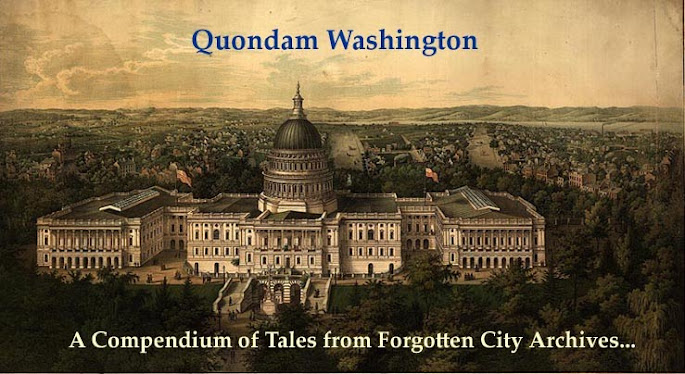
Panoramic View of WashingtonCity: from the new dome of the Capitol, looking east/drawn from nature and print in colors by E. Sachse & Co. Published by Casimir Bohn, c1857. Copyright by E. Sachse & Co. Courtesy Library of Congress Prints and Photographs DivisionWashington, D.C.20540USA