There's no fool like an old fool...Quondam Washington will take us back to one of 19th century Washington's juiciest scandals...it's the stuff you won't find in the history books. Stay tuned...
QW has been very remiss in attending to this blog, which she started with the greatest ambitions of maintaining.
However, as so often happens in life, her diligence has faltered due to changes in job and personal life. She apologizes to her readers, and offers amends in the form of a couple of memories she discovered while surfing the Wonder that is the Web this evening.
Like many Washingtonians of a certain age, she remembers the street car and Capital Traction systems which once criss-crossed the city and made driving an option. Metro has never quite managed to make up for the loss of the street car. Regard these clips which demonstrate the evolution of public transportation in Washington--and note that QW owes full credit to the folks who posted these on YouTube:
The Turn of the Century
1941 in Washington - or so says the post; to my eye it could be earlier
A Rather Sentimental trip from Georgetown to Glen Echo
It was a long shot--walking through this sad little cemetery in the farthest possible NW corner of Georgetown yesterday afternoon, hoping against hope to find the grave of the man, Noah Sedgwick, who I have been researching.
I knew that this cemetery would not likely be as manicured as its neighbor, Oak Hill. But I was stunned to see how neglected it had been over the ages, and that these mothers, fathers, sons and daughters were likely evaporated in the memories of the town in which they had lived and served.
So I began taking pictures. I took well over a hundred photos of every grave whose inscription was legible, and I shall try to post them here on this blog, so that any African Americans with a Georgetown heritage may be able to find long-lost ancestors.
I have looked up census info on a couple of the graves--ultimately, I will get as much information on each one as I can.
I've created a set on Flickr--AME Zion and Female Union Band Cemetery. Go to: http://www.flickr.com/photos/54312378@N02/
Feel free to download--credit is appreciated, but not necessary!
Perhaps somewhere out, a reader might recognize one of the young ladies in this photo, which QW found while indulging in one of her favorite pastimes, flea marketing.
The WilsonNormal School, first named the Washington Normal School, was established in 1873 to train young white high school graduates to become elementary school teachers. One of the school’s chief missions—as with “normal schools” all over the country—was to established standards of teaching or “norms”—thus, the term “Normal."
Predating the Wilson School, the Normal School for Colored Girls had been established in 1851; its name was thankfully changed to Miner Normal School in 1879.
The Washington Normal School changed its name to the JamesOrmondWilsonNormal School in 1913 to honor the then-superintendent of D.C. schools.
The School was originally housed in the Franklin School Building at 660 K Street, NW (left). It's first graduating class of 18 young white women began classes in September, 1873.
In 1911, Congress granted the white school money to erect a new building at Eleventh and Harvard Streets, NW (right). This was completed a year later and first occupied in 1913. Today, this delightful building houses the Carlos Rosario International Career Center.
The Miner College then occupied Franklin School.
In 1929, the US Congress turned both the Wilson and Miner Schools into four-year teaching colleges--they were renamed the Wilson Teachers College and Miner Teachers College respectfully.
In 1955, the segregated Wilson and Miner Teachers Colleges were merged to become the District of Columbia Teachers College--the precursor to the University of the District of Columbia.
Lena Gray, three of whose photos appear on QW's 1/17/2009 posting, may have been Josephine L. Gray, daughter of John A Gray, a prominent African American restaurateur in Washington during the second half of the 19th Century.
Gray was nominated by President Ullyses S. Grant, April 13, 1871, to serve as a member of territorial Washington's council of the legislative assembly, along with Frederick Douglass and others.
Gray's restaurant was said to have been one of the "first" restaurants in the city, and the African American newspaper, the Washington Bee, listed him as one of the "moneyed" members of DC's black society.
Gray was born in Washington, DC in 1835 to Jane and Basil Gray, a laborer. The family appears in the 1850 census as living in Ward 4.
By the 1850s, John had established himself as a caterer in Washington. For awhile, he had a restaurant which, according to the Bee and other sources, was popular among a predominantly white clientele.
The Gray family found itself the subject of some unwanted attention in February of 1859. John rented out a house he owned--at 383 15th Street, N.W., just two blocks away from Lafayette Square. His tenant? The dashing rake, Phillip Barton Key, the son of Francis Scott Key. Phillip was a US District Attorney who fell in love with the beautiful Theresa Bagioli, the wife of N.Y. Congressman Daniel Sickles.
For two years, the couple carried on, using the Gray house as their "love nest," according to George Rothwell Brown in his 1930 book, Washington: A Not too Serious History. Whenever Key wanted to meet his lover, he would stand in Lafayette Park within view of her windows and flap his handkerchief as a signal.
On Saturday night, February 26, Mrs. Sickles broke down and confessed everything in writing to her husband (published in Harper's Magazine, below, right).
The next evening, an unsuspecting Key waved his handkerchief as usual. It was Mr. Sickles who met Key, not Mrs. S.
Key, you scoundrel!" Sickles allegedly cried. "You have dishonored my bed–you must die!"
With that, he pulled out his two-dollar and fired at Key. He missed the first shot and as Key begged for mercy, he calmly walked up closer and shot him twice again.
As readers likely know, Keys died, Sickles was tried and acquitted of the murder by reason of temporary insanity. This was the first time such a defense had been admitted in US jurisprudence.
This is not so terribly surprising, as according to the thinking of the times, a man had a right to exact revenge on his wife's seducer--even if she had been a consenting party.
Sickles reunited--at least publicly--with his wife, but was shunned by Washington society forever after.
He retired in 1861.
Theresa died of TB in 1867.
And Quondam Washington supposes that John A. Gray found another tenant soon thereafter.
However, none of this answers the fundamental question--what really did become of the lovely Lena Gray?
Lena Gray, courtesy of the Photography Collections, University of Maryland, Baltimore County.
Washington Bee, courtesy the Library of Congress and National Endowment for the Humanities. Chronicling America is sponsored jointly by the National Endowment for the Humanities and the Library of Congress as part of the National Digital Newspaper Program (NDNP).
An excited Noah E. Sedgwick dipped his pen in ink and began a letter to John W. Ross, Commissioner of the District of Columbia:
Dr. Sir, I have the honor to make application for a patrol driver or the like under your branch of the District Government. I will faithfully discharge [sic] the duties assigned me. Your obedient Servnt, Noah Sedwick.
A month later, Sedgwick once again took up the pen and filled out an application for appointment to the Metropolitan Police Department:
13.Have you ever been indicted and convicted of any crime? Have not.
14.Are you addicted to the use of intoxicating liquors, morphine or opium? Not.
15.Have you ever been addicted to the use of any of these articles? No.
16.When did you last drink intoxicating liquors? March 11th, 92.
The application even asked whether Sedgwick suffered from piles or rheumatism.
It did not, however, ask him his race. As if this did not matter...
In researching a coming blog post, Quondam Washington came upon the following article, written in 1908, commenting on the near-complete segregation of blacks and whites in the Capital City (citation below).
The author, incidentally, was an African American.
A COLOR PHASE IN WASHINGTON
By Osceola Madden
In Washington, the great capital city of the greatest country on earth, the separation of the races is more nearly complete than in any other city of the union. This does not even except the South, for here, where there is the largest colored population of any of our cities, the largest point of contact, that of personal service, is growing smaller each year and white help in private homes, boarding houses and hotels is taking the place of colored, while "white barber's" shops, until recently unknown in the South, arc getting very common.
Shoe-shining parlors in the downtown districts, well appointed, with upholstered seats, electric lights and fans, periodicals and newspapers, have monopolized the trade of the once familiar black bootblack with box and chair.
In Washingtonthe colored infant is introduced to his existence by a colored physician, often in a colored hospital with colored staff and nurses (the Freedmen's is the largest in the District). When old enough he goes to a colored school to study and play with colored children only. He sees white children and grown-ups in the complete than in any other city of the union. This does not even except the South, for here, where there is the largest colored population of any of our cities, the largest point of contact, that of personal service, is growing smaller each year and white help in private homes, boarding houses and hotels is taking the place of colored, while "white barber's" shops, until recently unknown in the South, arc getting very common. Shoe-shining parlors in the downtown districts, well appointed, with upholstered seats, electric lights and fans, periodicals and newspapers, have monopolized the trade of the once familiar black bootblack with box and chair.
In Washingtonthe colored infant is introduced to his existence by a colored physician, often in a colored hospital with colored staff and nurses (the Freedmen's is the largest in the District). When old enough he goes to a colored school to study and play with colored children only. He sees white children and grown-ups in the streets, but nowhere else, and there is never contact unless a children's "race row" should happen. A colored dentist helps him get rid of his "milk teeth," and next day in a happy frame of mind he goes to a colored Sunday-school and a colored church.
After a course in the colored graded schools, should a profession be desired he can make a limited selection and get an excellent training at the one colored university, Howard. With the exception of the CatholicUniversity all the others are closed tight — for him.
Should he not have desired or have been unable to obtain, a professional education, when ready to look for a life vocation or compelled by circumstances to hustle for a living, he is certainly up against a hard proposition if he is intelligent and ambitious. The number of trades offering him opportunity to become a skilled mechanic is small, and industries in which he can secure profitable employment, regardless of his preparation and ability, are few. Without capital and experience, it is practically impossible for him to make a successful business beginning. What he shall do is not easy to decide.
Later, should he require legal assistance of any sort, excellent lawyers of color are ready to aid him, or if unfortunate enough to run afoul of the law he may be arrested by a policeman of his own race and have his case, if minor, tried before a colored magistrate. When he has lived a long and useful life, and all hope of local suffrage to help lessen the discrimination against him has departed, he gives up the ghost, and after a colored minister of the gospel has eulogized him in a colored church, a colored undertaker buries him in a colored cemetery. From beginning to end he has not crossed the color line.
As a matter of fact, in Washington, as in many other southern cities, the better classes of white and colored people know absolutely nothing of each other. They pass on the streets, sometimes, but that is as near as they ever get. In the schools, in the churches, in the various pursuits of gaining a livelihood, and —speak it gently — socially, the two races are entirely separate and apart.
According to the police census of last year the district has a population of 329,591, of which number 96,188 are colored people. Of approximately 450 clerks in the District (municipal) Building nine are colored men, a majority of the messengers and laborers being of the same race. The police force of 731 has thirty-eight colored officers on its roll, while nine of the 398 members of the fire-fighting force are colored. . The chief of the fire department says that he contemplates establishing a fire company composed entirely of colored men some time in the future.
In the city post office there are 556 white and seventy-nine colored clerks, including substitutes, and 325 white and fifty-five colored mail carriers on the list. Of the six city magistrates one is a colored man drawing a salary of $2,500. The colored Recorder of Deeds gets $4,000 as his annual compensation, and the president recently appointed a young colored lawyer as Assistant United States Attorney at a salary of $2,000.
The local school system is a dual one, the superintendent being white with a white assistant superintendent in charge of the white schools and a colored assistant in charge of the colored schools. For the 111 white and sixty-five colored school buildings there was an enrollment at the close of the last school year of 1,058 white teachers with 35,356 white pupils, and 517 colored teachers who gave instruction to 17,382 colored pupils.
For a great many years the government departments have drawn numbers of capable colored men with their families from all parts of the country, and there are now thousands of cultured, well-educated and refined colored people in the capital, many of them living in handsome and even elegant homes of their own. In this connection it may be worth while to state that of the total value of taxed property in the District of Columbia, $382,987,251 (this does not include government property to the value of hundreds of millions); nearly $23,000,000 worth is owned by colored people. This estimate is based upon the latest report of the Assessor of the District.
In the nine executive departments of the National Government there are approximately 1,450 colored employees, about three hundred of that number being clerks, drawing salaries ranging from $240 for the humble charwoman to $4,000 for the Register of the Treasury. The total amount paid these 1,450 employees is about $817,240 each year. One colored woman clerk enjoys a salary of $1,800. In addition to the Register of the Treasury, the Assistant Register, the Auditor for the Navy Department and, I believe, one or two chiefs of divisions are also colored.
The corps of instructors in the local schools includes graduates of Harvard, Yale, Amherst, and others of the leading colleges, as well as a few from Oxford and from the leading universities of France and Germany, and some who have studied in Italy and Spain. HowardUniversity, the foremost colored institution of learning in the country, and to which, by the way, Andrew Carnegie has recently donated $50,000 for a library, offers many advantages to the student in the higher branches, and is making an effort to include technical courses for those inclined to take more than the ordinary course in manual training. This institution is supported by Congressional appropriations and by private contributions.
Washingtonhas no large industries or business houses managed by colored men, and there is no colored bank. There are many small stores and enterprises operated successfully, and in a limited number of trades many colored men make a comfortable living.
Of the benevolent and kindred organizations the "True Reformers" are very prominent. The local manager states that the order has a membership of ninety thousand, spread over thirty-seven states, including five thousand in Washington. They have erected in the city at a cost of $100,000 a handsome structure which contains the armory for the colored militia, a commodious entertainment hall, a drug store, and a number of office and lodge rooms. The building has proved a paying investment.
Among the professional men of color are many lawyers, some of whom do well, a goodly number of dentists with all they can do, and physicians with large and in some instances lucrative practices. Of the 1,459 registered physicians in the city seventy-six are colored, about fifty being regular practitioners; a number of the others are government clerks, "Sun Downers," practicing after office hours. Some of these physicians do exceedingly well, one in particular having a sanatorium and dwelling in the residential portion of Pennsylvania Avenue, about six blocks from the White House, and valuable properties located in other parts of the city.
There are a number of colored architects, at least two being very successful with excellent work to their credit, an automobile establishment, ten drug stores, two of which contain sub-post office stations, and two first-class photographic studios. A colored woman conducts an establishment of considerable size with schools of instruction in dressmaking, millinery and cooking, and in addition an employment bureau. There is also a flourishing Conservatory of Music and School of Expression in its fifth year, with an enrollment of 178 pupils and eight instructors.
A Young Men's Christian Association and a like organization for young women are struggling to get well established, and in the southwest portion of the city a colored woman is conducting a social settlement, which is doing most excellent work among the poorer classes of colored people in that section.
There are 114 colored churches in Washington, of all denominations, a majority Baptist with a goodly number of Methodists; also Episcopal, Presbyterian, Seventh Day, Holiness, Catholic and Lutheran, which would seem to assure a happy future for the colored people now here, however the present may seem.
Geier Hertzog Ingersoll Jenkins Johnson Kiefer Killeen Kiefer
Leahy
Linthicum
Magruder
Murdock
Mussey Noack
Nodkinson
Oppenheimer
Pearson
Pugh
Register
Rickey
Sedgwick
Shekell
Sinkfield/Singfield
Shoomaker
Spurgeon
Sunderland Towle Walker Wynne
& So Many More!
Caveat
Updates, corrections and addenda added regularly. Stay tuned for more photos.
Why Quondam Washington?
quon·dam
(kwän′dəm, -dam) 1. [a] belonging to some prior time ; "erstwhile friend"; "our former glory"; "the once capital of the state"; "her quondam lover".
I was born in Georgetown, as were generations of my paternal ancestors. I was raised not on stories of Washington's Founders and Glorious Politicians, but on stories of regular folks-butchers, hucksters and firemen. When we gathered as a family, we didn't discuss the latest political scandals, but tales of murders, suicides, ghosts, religious miracles...
From a very young age, I was fascinated by Washington's other history and have been collecting these tales for years.
Sometimes when I drive downtown, I go into a sort of fugue state, in which I almost see the shadows of the folks who long ago walked its streets. I can hear the sound of taffeta petticoats whooshing, of footsteps in cobbled alleys and the clopping of horses hooves. I can smell good steaks sizzling at the old Leeches Buffet and the odor of the pigs that once rummaged in the city's gutters. I can walk down certain streets and point to buildings: "This was an oyster bar, this was a glove shop, here's where Madame Carlette read palms for a quarter, here's where Ada Paynce sold cast-iron corsets and Abner Drury brewed Old Glory Beer.
I am old enough to remember Georgetown before its gentrification was complete--stumbling over loose bricks in the sidewalks, turning our noses the other way when the fumes from the bone rendering plant along the waterfront turned north from the riverfront.
This is the Washington I seek to present in this blog--and I welcome both your comments and your own memories.
* Credits, Main Blog Image:
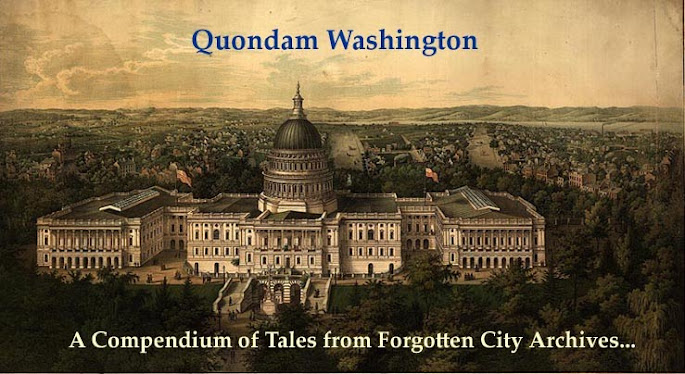
Panoramic View of WashingtonCity: from the new dome of the Capitol, looking east/drawn from nature and print in colors by E. Sachse & Co. Published by Casimir Bohn, c1857. Copyright by E. Sachse & Co. Courtesy Library of Congress Prints and Photographs DivisionWashington, D.C.20540USA